

Student Assistant (f_m_x) - Modeling mantle flow, true polar wander and core-mantle boundary heat flux GFZ Helmholtz Centre for Geosciences

The GFZ Helmholtz Centre for Geosciences is one of the world's leading institutions in the field of geosciences. As part of the Helmholtz Association, Germany's largest research organisation, we address global challenges such as natural hazards, climate change and the sustainable use of resources. In doing so, we combine cutting-edge research with social relevance. Our international staff - around 1,200 employees and approx. 500 guests - work in a multidisciplinary way and with a unique infrastructure to research the dynamic processes of the Earth system. Our vision: “Taking the pulse of the Earth to safeguard a habitable planet.”
For section 2.5 Geodynamic Modeling (department “Geophysics”), we are looking for a:
Student Assistant (f_m_x) - Modeling mantle flow, true polar wander and core-mantle boundary heat flux
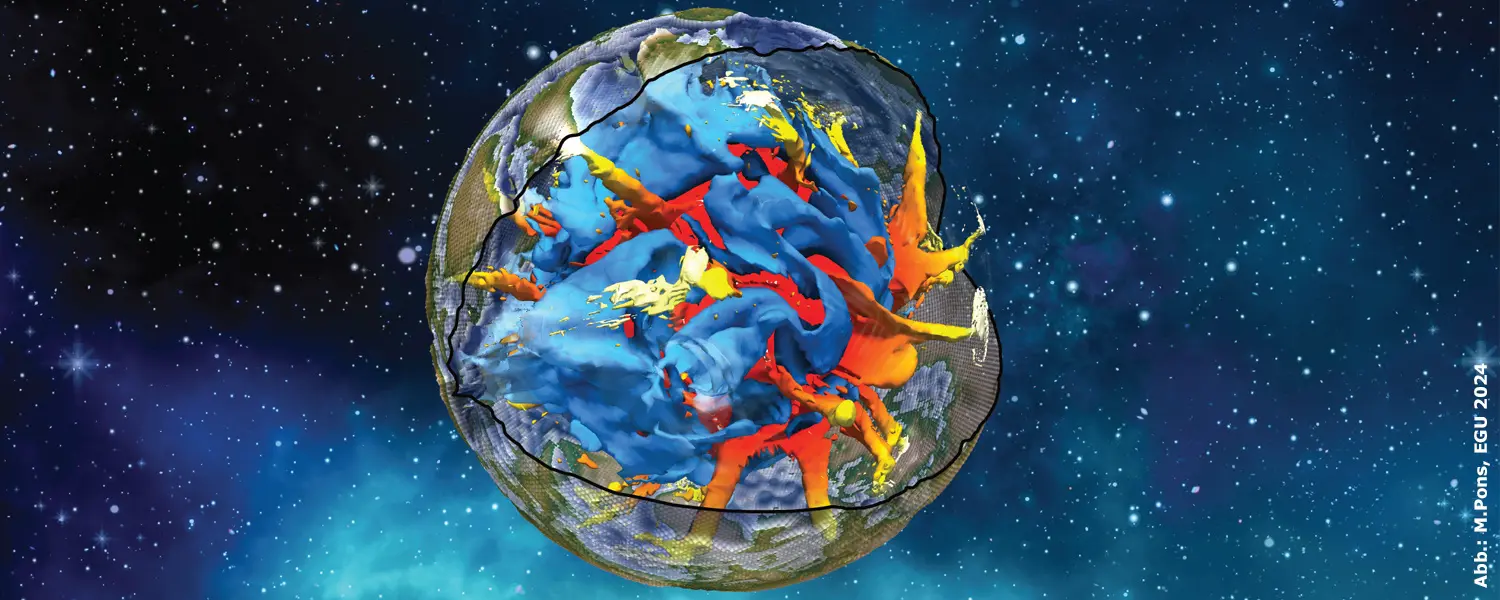
Our section is working on the understanding of geodynamic processes operating inside the solid Earth and their surface manifestation at a broad range of spatial and temporal scales through advanced numerical modeling. Our research foci are located at both plate boundaries and within the plate interiors, inside the deep mantle and at the surface. To approach our aims, we develop our own numerical methods and tools, but also extensively employ and co-develop numerical techniques provided by the international community.
We are looking for a student assistant to join our team within the DFG Priority Programme DeepDyn. Job responsibilities will include a variety of tasks related to geodynamic research, scientific programming, and data visualisation.
Your responsibilities:
Under the guidance of group members, you will:
- Set up and execute numerical models of mantle convection, including, but not limited to, computing (1) mantle density anomalies and flow, (2) true polar wander, and (3) core-mantle boundary heat flux
- Develop scientific visualisations of the results and prepare graphical output
- Evaluate the output both numerically and visually
- Present your results at group meetings
About You:
Essential Qualifications:
- A completed bachelor's degree in geosciences or a related field (e.g., physics)
- Good to very good knowledge of physics
- Experience working on a computer
- Very good written and spoken English skills
- Excellent ability to work in a structured and organised manner
- Good communication skills
- High level of reliability and precision in work
Desirable Qualifications:
- Good knowledge of structure and processes in the Earth's interior
- Experience working under a Linux operating system and with high-performance computing
- Good programming skills, for example in Python, Fortran or C++
- Experience in data visualisation and scientific programming
- Enthusiasm for, curiosity about and interest in geodynamic modeling
What we offer:
- Ambitious and varied tasks in a dynamic and international research environment
- State-of-the-art equipment
- Flexible working hours and conditions
- Working at the Albert Einstein Science Park on the Telegrafenberg in Potsdam
- Workplace within walking distance of Potsdam main train station, or just a short ride on the shuttle bus
Start date: As soon as possible
Fixed-term: 6 months, with the option to extend (this requires a valid enrollment certificate in full-time study)
Salary: The monthly remuneration for student and research assistants is determined in accordance with the guidelines of the TDL. Currently, the hourly rate for student assistants is €15.20 gross (without a bachelor’s degree) and €15.81 gross (with a bachelor’s degree). For research assistants, the hourly wage is €21.03 gross (with a Master’s degree).
Working hours: 9,5 hrs/week (approx. 38 hrs/month)
Place of work: Potsdam
Have we piqued your interest?
If so, we look forward to receiving your application by 21st October 2026. Please use our online application form only.
Required documents: Curriculum vitae and a valid certificate of enrolment as a full-time student at a German higher education institution
The GFZ actively promote diversity and equal opportunities. We explicitly welcome applications from all qualified individuals, regardless of ethnic and social origin, nationality, gender, sexual orientation and identity, religion/belief, age, and physical or neurodiverse abilities.
“Diversity in perspectives” is one of GFZ's core values. As an integral part of supporting diversity at our centre, we actively promote women in science and in leadership positions. To know more about our Diversity policies, contact the diversity team. If you need more information about our gender equality policies, please do not hesitate to contact our Equal Opportunities Officer and check our Equal Opportunities Plan & Cascade Model.
We look forward to applications from people who enjoy working in diverse teams, where everyone feels respected and valued and can fully develop their own talents. Applicants with severe disabilities and equalised persons will receive preferential consideration if equally qualified.
Data protection information for applicants
In case of any further queries regarding the field of activity, please contact Dr. Bernhard Steinberger via email. If you have any general questions about the application process, please contact our recruiting team at our phone number +49 (0) 331 6264‑28787.



Reference number
11558
Additional actions
About the employer
GFZ Helmholtz Centre for Geosciences

GFZ Helmholtz Centre for Geosciences
The GFZ is Germany’s national center for research on the solid Earth. We advance the understanding of dynamic processes to address global challenges—ranging from mitigating the impacts of natural hazards and preserving our environment in times of global change to the responsible management of natural resources. We are a member of the Helmholtz Association, Germany’s largest scientific organization. With approximately 1,200 staff and around 500 visiting researchers, we contribute to the Helmholtz research area “Earth and Environment,” combining cutting-edge research with societal relevance and international collaboration.
Our work integrates multidisciplinary studies of Earth’s systems and leverages advanced technologies and infrastructures to explore solutions and bring our knowledge into society. We do all this in line with our vision: “In tune with the Earth—to preserve it as a habitable planet.”
Benefits
Receive similar jobs by e-mail?
Subscribe to our job mail!
Similar Jobs

Max-Planck-Institut für Chemische Physik fester Stoffe
Deutsches Krebsforschungszentrum (DKFZ)
Max-Planck-Institut für Struktur und Dynamik der Materie (MPSD)